
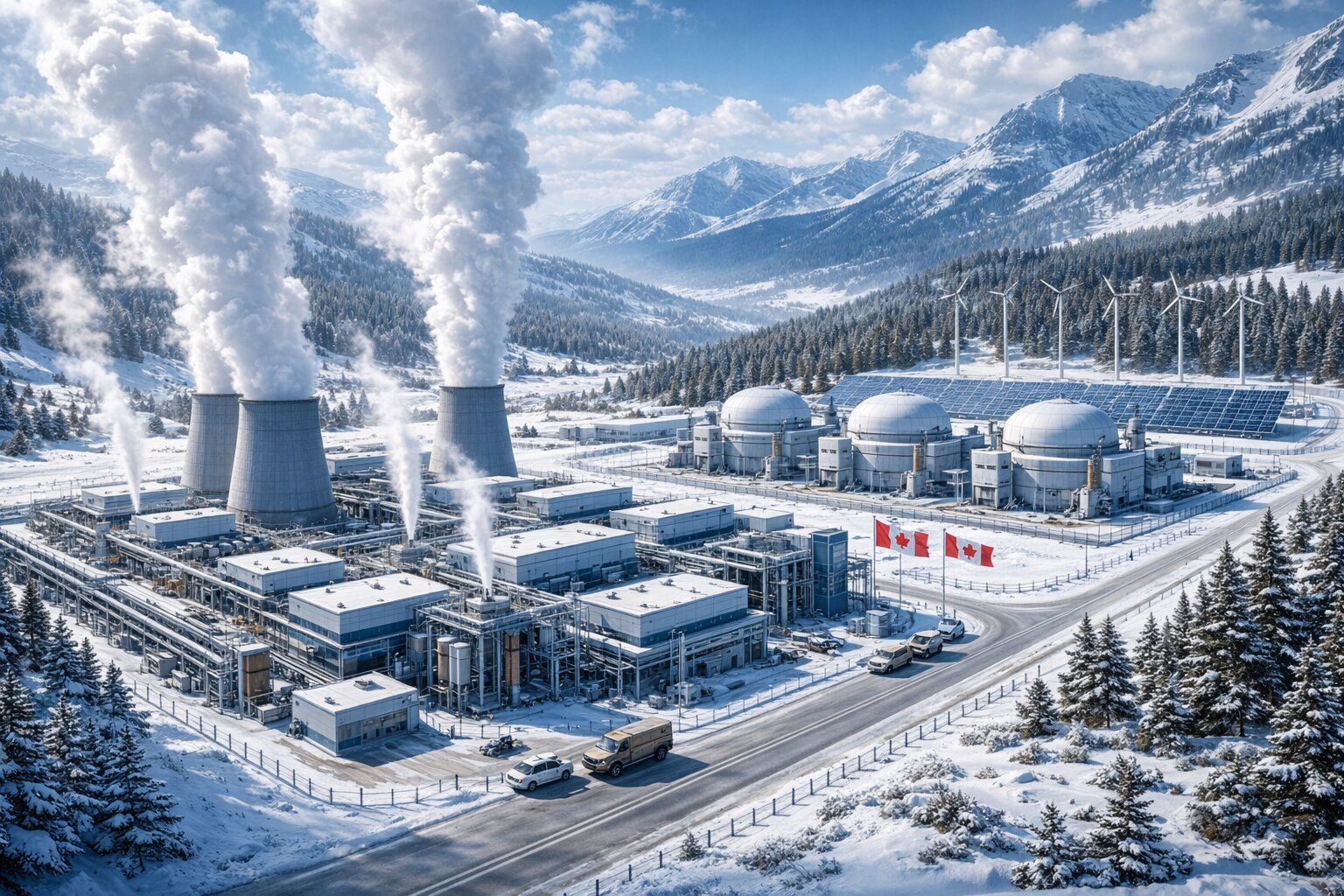
Chapter 11 – Pillar I: Laying The Foundation
Before Canada can transform its economy, it must first clean up the systems that power it. This chapter introduces the first pillar of the plan.

In the late 1950s, Charles David Keeling wasn’t trying to change the world. He was trying to resolve a scientific disagreement. At the time, researchers suspected that burning fossil fuels was increasing the concentration of carbon dioxide in the atmosphere, but the evidence was inconsistent. Measurements varied widely depending on location, time of day, and method. No one could say with confidence whether CO₂ levels were actually rising, or by how much.
Keeling believed the problem wasn’t theory, but measurement. If atmospheric carbon dioxide was changing, it would only be detectable through precise, continuous readings taken far from local pollution sources. With newly developed instruments capable of that precision, he set out to establish a reliable baseline.
He began taking daily measurements at a remote observatory on the slopes of Mauna Loa in Hawaii. The data behaved as expected at first, rising and falling with the seasons as plants absorbed and released carbon. But over time, another pattern emerged. Each year’s baseline was slightly higher than the last.
Keeling hadn’t set out to prove that the planet was warming. But the data made one conclusion unavoidable. Human activity was steadily increasing the concentration of greenhouse gases in the atmosphere—not in dramatic leaps, but through a slow, cumulative rise. Left unchecked, that change would alter the climate system itself, with devastating consequences.
Currently, the Earth is already about 1.2°C warmer than it was in the late 1800s, and emissions continue to rise. To keep global warming to no more than 1.5°C, emissions need to be reduced by 55 per cent by 2035 and reach net zero by 2050.
- United Nations, Climate Action
Over time, those measurements were joined by others: temperature records, ice cores, satellite observations, and increasingly sophisticated climate models. Together, they converged on the same conclusion. Continued emissions would push the planet into more frequent and severe disruption. Limiting the damage meant staying within clear physical boundaries—boundaries that eventually became public targets, like holding warming below 1.5 or 2 degrees Celsius.
By the time those targets entered political debate, the core uncertainty was gone—and so was much of the time needed to act. Decades had passed since the underlying trend was first measured, and emissions were still rising. The science had done its job early. The response came late.
What followed was not a surge of coordinated action, but a gradual, cautious approach that consistently fell short of what the evidence called for. Today, global emissions remain high, and current trajectories take us well beyond the two-degree threshold scientists identified as a critical boundary. Crossing it doesn’t mean the end of the world—but it does mean a seismic shift in daily life, economic stability, and environmental risk. Heat waves become more frequent and intense. Sea levels rise. Ecosystems degrade. Economic and social strain grows. Those consequences were well understood. What remained unresolved was how far governments were willing to go to avoid them.
To put it bluntly, decades of inadequate action have put the 1.5 degrees Celsius goal further out of reach and world leaders are failing their people.
- Dr. Rachel Cleetus, Policy Director at the Union of Concerned Scientists (2024)
Government climate policy today is timid at best—not because the problem is unclear, but because confronting it would require disrupting the status quo. Targets are announced, press releases are issued, and carefully calibrated incentives are rolled out, all while the systems driving emissions remain largely intact. Political leaders speak the language of ambition, but govern with extreme caution, constrained by short election cycles, industry pressure, and a deep aversion to risk. The result is a steady accumulation of half-measures that create the appearance of action without delivering the outcomes the science demands.
In Canada, this failure is palpable. For nearly a decade, the federal government had both political capital and a clear policy lever in the form of a national carbon tax. In principle, it was meant to put a price on pollution and drive investment toward cleaner alternatives. In practice, most of that revenue was returned directly to lower income households, functioning less as a tool for transformation than as a blunt wealth redistribution mechanism. Very little of it was used to build the infrastructure needed to actually decarbonize the economy. The opportunity cost of that decision is enormous. Between 2022 and 2030, the carbon tax was projected to generate roughly $218 billion in revenue—enough to make meaningful, visible progress on clean power generation, industrial decarbonization, and the energy systems this book has spent chapters exploring.
The result was predictable. Emissions reductions lagged. Major energy, industrial, and transportation systems remained largely unchanged. And by 2025, Canada remained the worst performer on climate action among the G7 member states. By the time the policy’s political costs came due, public trust had eroded. The carbon tax became wildly unpopular—not because Canadians rejected climate action, but because they were asked to pay for it without being shown what they were building in return. When the policy collapsed under its own weight, it didn’t just undermine a tax. It undermined confidence that governments were capable of delivering serious climate solutions at all.
Many perceive the carbon tax as a proxy for all climate policy. Rising solutions skepticism is further weakening support for climate policy. While three-quarters of Canadians agree that polluters should pay for their pollution, fewer than half support the carbon tax.
- Hatch, C. et al., What Do Canadians Really Think About Climate Change? Re.Climate study (2024)
We have known what needs to be done for years. Commitments were made publicly, including under the Paris Climate Agreement, with explicit timelines and clear expectations. Yet no government has presented a coherent, end-to-end plan that shows—step by step—how those commitments will actually be met. Not at national scale. Not with credible costings. Not with infrastructure timelines that match the urgency of the problem. Instead, responsibility is fragmented across departments, jurisdictions, and election platforms, until accountability all but disappears. What remains is a widening gap between promises and reality.
At this point, failure is no longer a matter of uncertainty or technological limits, but of choice. The technologies exist. The pathways are well understood. What has been missing is not money, but direction—clear priorities, sustained investment, and the political resolve to assemble them into a single, coordinated plan, and to be honest with the public about what it will cost, what it will return, and what it will take to see it through.
Acting at scale is often framed as prohibitively expensive, when in reality it is an investment in energy systems, food security, materials, and environmental repair—one that generates returns over time. The real choice is not whether to spend, but whether to spend deliberately, building assets that last, or continue paying the rising costs of inaction: escalating disasters, lost productivity, and a perpetually rising cost of living.
The coming chapters lay out what that deliberate approach could look like. Not a single policy or silver bullet, but a coordinated plan—one that directs investment where it actually changes outcomes, makes costs and returns explicit, and treats climate action as the long-term national project it has always needed to be.
Climate change is already making life across Canada less affordable and hurting companies’ bottom lines, causing more extreme and unpredictable weather that’s disrupting supply chains and driving up costs for materials, insurance, and repairs.
- Rick Smith, President of the Canadian Climate Institute (2025)
To make the scale of this plan manageable, it’s broken into four pillars. Each addresses a different failure in how we’ve approached climate action to date: how we clean up the systems we already rely on, how we build a new energy economy, how we adapt to changes we can no longer avoid, and how we repair the damage that’s already been done. Within each pillar, the focus is the same—clear objectives, realistic costs, and the returns we can expect over time. In the end, those pieces are brought together so we can see, clearly and honestly, both the scale of the investment required and what we stand to gain from it. Together, these pillars impose order on a problem that has never had a unified plan—addressed instead through a patchwork of discrete actions by governments, markets, and civil society.
The plan that follows is not a collection of disconnected policies. It is structured around leverage—starting with the systems that make all other climate action possible.
Electricity sits at the center of that structure. Since clean power underpins transportation, industry, and clean fuels, its reliability determines whether most other climate solutions succeed or fail. Without firm, reliable, emissions-free electricity, many of the solutions explored in earlier chapters remain constrained or theoretical.
Canada’s advantage is that much of this foundation already exists. Hydropower and nuclear have given the country a head start few nations enjoy. But that advantage is incomplete. Fossil generation remains embedded in the grid because it provides something the system still depends on: dependable power when conditions are least forgiving. Any serious climate plan must begin by replacing that function—not just the energy fossil fuels produce, but the reliability they supply.
For that reason, the first pillar of this plan focuses on cleaning up the systems we already rely on. It begins where leverage is highest and the consequences of failure are most immediate: the electricity grid itself.
Pillar I does not start with ideology or averages, but with firm capacity—because reliability is the condition that determines whether climate action earns public trust or loses it. It is the foundation on which every pillar that follows depends.
Curious about why I wrote this book? Read my Author’s Note →
Want to dive deeper? A full list of sources and further reading for this chapter is available at: www.themundi.com/book/sources
Before Canada can transform its economy, it must first clean up the systems that power it. This chapter introduces the first pillar of the plan.
Help shape the future! Sign up to receive behind-the-scenes updates, share your ideas, and influence the direction of my upcoming book on climate change.