
A Note From the Author
As a systems thinker, I weave together solutions from across disciplines to tackle the biggest challenge of our time.

This is the longest chapter in the book so far. A table of contents is provided below to make navigation easier.
Modern societies are built on systems so reliable we rarely notice them at all. Electricity arrives when a switch is flipped. Heat is available through the coldest nights. Factories, hospitals, and data centres run continuously, without most people ever needing to think about how that reliability is maintained.
Those systems tend to become visible only when they fail. Power outages, fuel shortages, and price spikes don’t just cause inconvenience—they trigger cascading effects across the economy and public life. When essential systems become unstable, even temporarily, tolerance for disruption collapses quickly. Because these systems must be available at all times, they are built first for reliability and only second for efficiency or cleanliness. In practice, that trade-off has long favored fossil fuels.
Canada emits roughly 700 megatonnes of greenhouse gases each year. No single sector accounts for all of it, and no single solution will eliminate it. But some parts of the system offer far more leverage than others.
Electricity is one of them—not because it is the largest source of emissions, but because it sits upstream of almost everything else in the economy. Clean power makes electrification possible. It enables clean hydrogen production. It determines whether decarbonizing industry, transportation, and heating is feasible or merely aspirational.
In this respect, Canada starts from a position of unusual strength. Nearly 60 percent of the country’s electricity already comes from hydroelectric power, a legacy advantage that few nations can match. Add nuclear to the mix, and the majority of the grid is already emissions-free. This means the challenge ahead is not to reinvent the system from scratch, but to finish a job that is already well underway.
And yet, despite this head start, roughly 21 percent of Canada’s electricity is still generated using fossil fuels, producing about 105 megatonnes of greenhouse gases each year. That remaining slice exists for a reason. It provides dependable, on-demand power, filling gaps during peak demand and keeping the system stable when conditions are less than ideal. Any credible plan to clean up the grid must replace not just the energy those plants produce, but the reliability they provide.
Canada is among the top ten countries with the largest cumulative emissions, and thus a significant historical responsibility for causing the climate crisis. On a per-capita basis, it is within the top two.
- Climate Action Network, 2024
Average uptime doesn’t matter if the grid fails at the wrong moments. Electricity systems do not run on averages. They run on firm capacity. Power must be available through winter cold snaps, calm nights, and extended periods of peak demand. When those guarantees fail, the consequences are immediate: price spikes, outages, and public backlash that can undo years of progress overnight.
Wind and solar have an important role to play, and they will continue to expand. But they are fundamentally intermittent, with capacity factors well below those of conventional power plants. As their share of the grid grows, so does the need for long-distance transmission, large-scale storage, and backup generation that often remains fossil-based. At small scales, these trade-offs are manageable. At national scale, they become structural constraints. What appears cheap per unit of installed capacity quickly becomes expensive once the full system required to support it is taken into account—along with the vast land footprint needed to deploy it at scale.
Hydropower feels like the obvious answer because it’s already woven into Canada’s identity. Dams, reservoirs, and transmission lines—built over decades—are the reason we start this transition ahead of most nations. But for all its advantages, hydro is no longer a limitless solution. It depends on reliable water supplies, and climate change is making that reliability harder to count on. In 2024, the province of Quebec was forced to increase its use of diesel by 37 percent to generate electricity because drought conditions reduced hydropower capacity.
79 percent of Canada’s electricity was generated from low-carbon sources in 2024, almost twice the global average of 41%.
Ember Energy Report (2025)
Drought doesn’t just reduce river flow; it forces trade-offs. Reservoirs must balance electricity generation, drinking water, irrigation, and flood control—often in the same season. In that environment, hydro remains valuable, but it is no longer a firm foundation we can simply scale without consequences. Once these realities are accounted for, the solution space narrows sharply.
What remains are technologies capable of delivering firm, emissions-free power around the clock, at scale. In Canada’s case, that means nuclear and geothermal. Their output does not rise and fall with rainfall, wind speed, or when sunlight is available. It is steady and continuous, regardless of the weather. Both have capacity factors above ninety percent. Both can replace fossil baseload directly, without requiring a fundamentally different grid to support them. They are not speculative technologies or distant breakthroughs. They are proven systems that already exist—underused not because they don’t work, but because deploying them requires long-term commitment and upfront investment.
This pillar is about transforming the energy system we rely on today—not tearing it down, but making it cleaner and more resilient without giving up reliability. The aim isn’t an idealized grid, but one that can actually carry the transition forward.
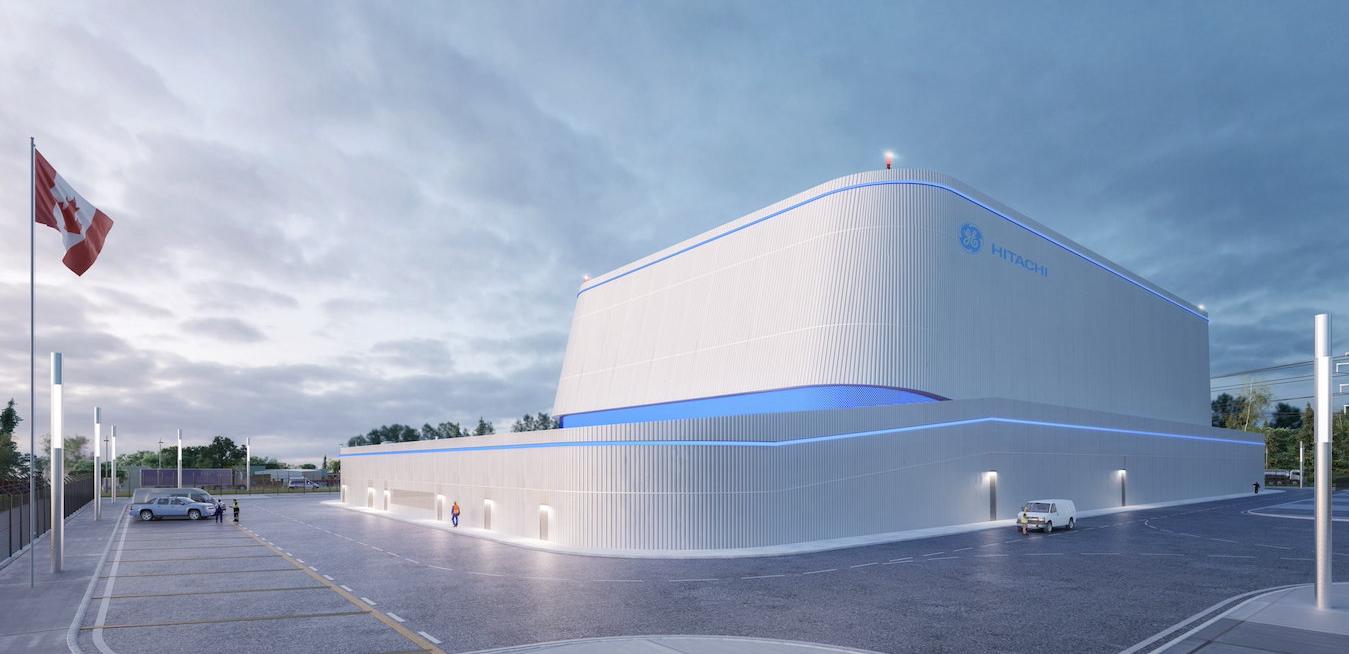
An artist's rendition of GE Vernova Hitachi's BWRX-300 small modular nuclear unit. Courtesy of GE Vernova Hitachi
Every modern electricity grid, regardless of how clean it is, must deliver two things: reliability and flexibility. Power has to be available at all times—during winter cold snaps, summer heat waves, and unexpected failures—and it must respond quickly when demand rises or supply falls. Hospitals, data centres, transit systems, and industrial supply chains depend on it. When grids fail to deliver either reliability or flexibility, the consequences are immediate—higher costs, public backlash, and pressure to use more fossil fuels.
The global push for renewable energy has brought solar and wind to the forefront, with costs falling rapidly thanks to mass production and scale. By 2021, building a gigawatt wind farm cost around $1.72 billion USD, while a solar farm of the same size—using sun-tracking panels—was even cheaper at roughly $1.33 billion USD. On paper, these technologies look like obvious winners.
However, capacity is not output. Once capacity factor is accounted for, the math changes quickly. Replacing a single gigawatt of continuous fossil power requires several gigawatts of solar or wind, along with extensive storage and transmission infrastructure. The result is higher system costs, vastly larger land footprints, and far greater complexity.
Achieving the generating capacity to replace fossil fuels with wind power in Canada would require the deployment, and regular maintenance, of almost 23,000 wind turbines and a supporting battery infrastructure of staggering proportions.
- Author’s Calculation (See Appendix 11A - Estimated Number of Wind Turbines Required to Replace Fossil Fuels in Canada)
Scaling solar presents similar challenges. A solar installation would require roughly three gigawatts of nameplate capacity—plus storage—to match the annual output of a single one-gigawatt natural gas plant running continuously. That translates into 9,000 to 12,000 hectares of land, enough to blanket an entire small city in panels. These are real physical constraints that cannot be ignored at national scale.
This is why natural gas still plays such a large role in Canada’s electricity system. Gas plants persist not because policymakers ignore climate change, but because they are cheap to build, fast to dispatch, and flexible enough to respond to sudden swings in demand. In system terms, natural gas does two jobs at once: it provides firm baseload power and acts as backup during peak demand. Any plan that removes gas without replacing both functions is a gamble with reliability, affordability, and public trust.
But that convenience comes with hidden costs. Natural gas looks cheap because much of its real cost never appears on the balance sheet. The climate damage caused by its emissions is externalized, and long-term fuel prices are assumed to remain manageable. Over a multi-decade horizon, both assumptions are fragile. Fuel markets are volatile, carbon constraints will tighten, and exposure to global supply shocks increasingly shapes domestic energy costs. Gas plants may be inexpensive to build, but they lock the grid into decades of fuel dependence and price risk.
Figure B - Comparing Lifetime Costs of Power Plant Technologies (2024):
| Technology | Capex ($B) | Fixed O&M 30y ($B) | Variable O&M 30y ($B) | Fuel 30y ($B) | Capacity Factor | Generation 30y (TWh) | Total 30y ($B) | All-in ($/MWh) |
|---|---|---|---|---|---|---|---|---|
| Natural Gas CC (multi-shaft) | 0.824 | 0.370 | 0.546 | 4.479 | 60% | 157.680 | 6.219 | 39.44 |
| Geothermal | 3.097 | 4.888 | 0.000 | 0.000 | 90% | 236.520 | 7.986 | 33.76 |
| SMR (Nuclear) | 9.314 | 3.717 | 0.763 | 1.656 | 90% | 236.520 | 15.449 | 65.32 |
| Solar PV (tracking) | 1.379 | 0.687 | 0.000 | 0.000 | 20% | 52.560 | 2.066 | 39.31 |
| Wind (onshore) | 1.626 | 1.007 | 0.000 | 0.000 | 30% | 78.840 | 2.633 | 33.39 |
* Calculations are assuming a power plant with 1,000 MW of installed capacity. Complete calculations and assumptions can be found in Appendix 11B – Calculating Levelized Costs for Power Plant Technologies.
* Source: U.S. Energy Information Administration, Assumptions to the Annual Energy Outlook 2025
The contrast becomes clearer when costs are compared over the lifespan that actually matters. A modern natural gas plant can be built for roughly $1.5 billion per gigawatt of capacity. Geothermal and nuclear cost several times more upfront. That difference is why gas dominates new construction.
But capital cost is only part of the equation. Over a typical thirty-year operating life, a gas plant can accumulate billions of dollars in fuel costs alone, before accounting for carbon pricing or volatility in global markets. Geothermal has no fuel costs at all. Nuclear fuel costs are low and predictable. When lifetime operating costs are included, the apparent cost advantage of gas narrows dramatically—and in some cases disappears entirely.
Gas tends to win in the first decade. Clean firm power wins over the decades that follow. Hydropower became Canada’s backbone because it was built as long-lived public infrastructure, not as a short-term financial product. Alberta’s dependence on fossil fuels reflects the short-term investment structure. Replacing natural gas therefore requires more than a cleaner fuel. It requires a cleaner system.
The world now invests almost twice as much in clean energy as it does in fossil fuels. A secure and affordable transitioning away from fossil fuels requires a major rebalancing of investments.
- International Energy Agency, World Energy Investment 2024
Electricity markets are structured around short investment horizons, not multi-decade infrastructure. Under current market rules, natural gas plants are the easiest financial product to approve. The cheaper capital requirement for natural gas plants means faster returns for investors. That advantage is built into how power projects are financed, approved, and rewarded.
Geothermal and nuclear are capital-heavy, slow to permit, and designed to pay off over decades. Construction risk, regulatory uncertainty, and volatile power prices make them unattractive to private investors—even when their long-term value is higher.
To build a cleaner power grid, the first step is separating the roles gas currently plays. Baseload power—the steady electricity required day and night—does not need to be flexible. It needs to be dependable. Flexibility, by contrast, is required only during short periods of peak demand and system stress. Once those functions are disentangled, the replacement strategy becomes clear.
In Canada, firm baseload power should come from technologies designed to run continuously regardless of weather or season. That means geothermal energy and nuclear power—particularly Small Modular Reactors that can be deployed incrementally rather than through massive, high-risk megaprojects. Both operate with capacity factors above ninety percent. Both are unaffected by wind, sunlight, or rainfall. Both can replace natural gas baseload directly without requiring a fundamentally different grid architecture.
Small Modular Reactors and geothermal power give us what we need to end our dependence on fossil fuel combustion for powering our cities. That means committing to a nationwide infrastructure initiative to build enough nuclear and geothermal capacity to completely replace coal and natural gas for generating baseload electricity.
Fossil fuels generated approximately 142.4 terawatt-hours of electricity in Canada in 2023. Replacing that annual output with firm clean power operating at ~90 percent capacity factors requires roughly 18 gigawatts of new baseload capacity.
- Author’s Calculation (See Appendix 11C – Calculating Clean Energy Capacity Required to Replace Fossil Fuels in Canada)
Eighteen gigawatts is substantial, but not impossible to build. Spread across provinces over two or three decades, it represents sustained construction with predictable annual additions of firm capacity. The scale is large enough to reshape the grid, yet bounded enough to plan and finance responsibly.
Geothermal has a particular advantage over time. While its upfront capital costs are higher than gas, its fuel costs are effectively zero. Once built, operating expenses remain stable for decades. Natural gas follows the opposite profile: low capital costs followed by long-term exposure to fuel price volatility and carbon pricing risk. Over a thirty-year lifespan—the horizon that actually matters—geothermal becomes increasingly competitive, not less.
Nuclear fills the gaps geothermal cannot. It can be deployed anywhere in the country, delivers the same level of firm output, and offers long asset lifetimes with predictable performance. Together, geothermal and nuclear replace the single most valuable attribute of natural gas: cheap, guaranteed power—not on upfront cost alone, but on lifetime value and system stability.
Flexibility can then be handled separately. Short-duration fluctuations can be managed with sodium-ion batteries, built from abundant materials and free from the supply constraints that complicate lithium-based systems. While they store less energy per unit weight, that limitation is irrelevant at grid scale. What matters is cost, durability, and scalability. Longer-duration backup—needed only during rare peak events—can be provided by hydrogen, used sparingly and strategically rather than as a primary fuel source. In this configuration, combustion becomes the exception, not the rule.
This approach does not attempt to outcompete natural gas on every metric. It doesn’t need to. The objective is to outperform it where it matters most: over time, at scale, and without locking the grid into rising fuel costs, volatile markets, and ongoing emissions.
Power purchase agreements funded 19 gigawatts worth of new capacity in Europe in 2024, and issuers are beginning to integrate battery storage into such contracts to guarantee continuous energy supplies.
- World Economic Forum, 2025
If we want geothermal and nuclear at scale, government involvement is unavoidable—not because markets are broken, but because they are doing exactly what they are designed to do. The role of government is not to micromanage projects, but to absorb risks that private capital cannot carry alone.
In practice, this means reducing risk where markets cannot: long-term revenue certainty, predictable permitting timelines, standardized designs, and lower financing costs through public guarantees. The goal is not to replace private capital, but to make clean firm power investable on the same footing as fossil infrastructure once was.
Small Modular Reactors, in particular, are designed to benefit from assembly-line repetition. Their promise lies not only in smaller size but in standardization—reactors built from the same design, manufactured in controlled environments, and deployed repeatedly rather than reinvented each time.
Today, SMRs are still expensive in part because we build them as first-of-a-kind projects. Each unit carries the cost of custom engineering, one-off licensing, and supply chains that never get the chance to mature. This is not a technical failure. It’s a deployment failure.
Costs fall when units are built as a fleet. Designs stabilize. Construction timelines shorten. Supply chains form. This is how aircraft, ships, and every major industrial technology reached affordability—and there is no reason nuclear should be an exception. The economics of SMRs only work when we stop building prototypes and start building products.
Geothermal and nuclear will not match natural gas on short-term profitability, but that is not the benchmark that matters. What they provide is firm, emissions-free power with predictable costs, decades-long lifespans, and no exposure to fuel markets or carbon risk. In a warming climate, those qualities are critical for a reliable grid.
Build approximately 18 gigawatts of firm, emissions-free baseload capacity using a balanced mix of Small Modular Nuclear Reactors (SMRs) and geothermal power over the next two decades. This would be sufficient to replace nearly all remaining fossil electricity generation in Canada.
This is infrastructure spending, not consumption. Once built, these assets operate for decades with predictable costs and minimal fuel price exposure.
* Full assumptions and calculations are provided in Appendix 11D – Capital and Operating Cost Assumptions for Clean Baseload Power
NOTE: These economic returns are conservative. In practice, large clean-energy projects in Canada can claim accelerated depreciation (CCA), which typically reduces taxes substantially in the early years. After the 30-year amortization period, the same assets continue operating; at the assumed price and operating cost, they generate roughly $19B per year in gross operating surplus (about $14B after tax), for as long as the plants remain in service.
* Full assumptions and calculations are provided in Appendix 11E – Revenue and Carbon Offset for Clean Baseload Power
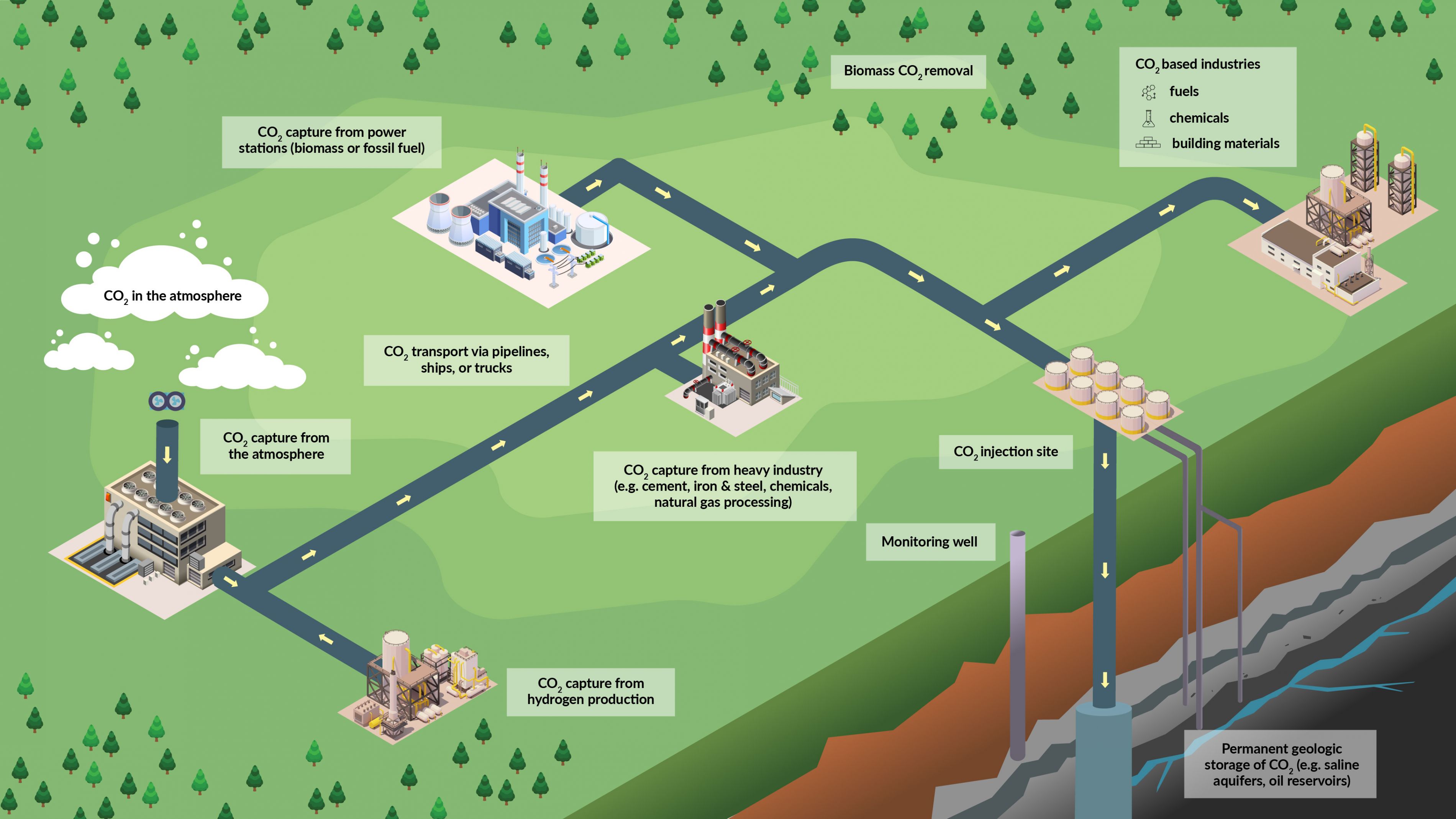
Diagram of carbon management processes as proposed by The Government of Canada
Even if Canada builds eighteen gigawatts of nuclear and geothermal capacity, fossil fuels do not disappear the day those plants come online. Coal is the easier problem. It accounts for less than four percent of Canada’s power generation, and much of the remaining fleet is nearing retirement. Replace it with clean firm power and move on.
Natural gas presents a more complicated challenge. Many of Canada’s largest gas plants are less than fifteen years old, financed over multi-decade timelines and integrated into provincial grids as core reliability assets. Utilities built contracts around them, and operators rely on their ability to ramp quickly during winter cold snaps and unexpected supply shortfalls. These are not relics of an earlier energy system. They are working infrastructure—assets that keep the grid stable—but they emit carbon every hour they run.
Shutting them down overnight would destabilize electricity markets in provinces that still depend on them. Prices would rise and reliability would suffer. Leaving them untouched, however, would lock in decades of additional emissions at a time when Canada already ranks among the highest per-capita emitters in the world. A responsible path forward must hold both realities at once: the lights must stay on, and emissions must fall.
Carbon capture offers a way to reduce emissions immediately while replacement systems scale. Instead of discarding existing infrastructure outright, the system is redirected. The same workforce that drilled wells and managed reservoirs can develop geothermal systems and operate underground storage sites. Natural gas paired with capture can also support blue hydrogen production during the transition, allowing cleaner energy systems to expand without destabilizing the grid in the meantime.
The economic benefit of three large-scale carbon capture and storage (CCS) projects in Canada could lead to an increase of $2.7 billion in GDP based on a 4-year construction and development timeframe.
- Canada’s Carbon Management Strategy, Government of Canada (2023)
Captured CO₂ must then be transported and either stored or utilized. Canada is well positioned for this step, already operating thousands of kilometres of pipelines for natural gas and petroleum. Moving carbon dioxide through similar infrastructure is technically straightforward, but it must be done at scale. Transporting CO₂ by truck over long distances increases both cost and emissions, reducing the overall benefit of capture. Dedicated pipeline networks and regional storage hubs offer a far more efficient long-term solution.
Captured carbon does not always have to be treated purely as waste. In some cases it can be sold. Carbon dioxide is already used in enhanced oil recovery, fertilizer production, beverage manufacturing, and several industrial processes. It can also be injected into concrete during curing, strengthening the final material while permanently locking emissions into bridges, buildings, and infrastructure.
These uses help offset costs but cannot absorb the full volume of captured emissions at national scale. Most captured carbon would still require permanent geological storage. Retrofitting plants for capture is also expensive. The capture equipment itself can cost nearly as much as the original facility, and operating it consumes energy—often fifteen to twenty-five percent of the plant’s output. Capture rates approach ninety percent under stable conditions but never reach one hundred, and storage infrastructure must be developed and monitored for decades.
In order to achieve mid-century net-zero climate goals, natural gas plants (new and existing) will need to use carbon capture, utilization, and storage capabilities.
- Center for Climate and Energy Solutions, (2025)
Carbon capture is not a perfect solution, but it is a necessary one. Without it, existing gas infrastructure would continue emitting for decades while the next generation of clean firm power is built.
Gas with capture will cost more than conventional gas. That is unavoidable. Maintaining the status quo, however, does not shield consumers from rising costs either. Fuel volatility, aging infrastructure, and climate-driven disruptions already affect the price of electricity generated from fossil fuels.
Carbon capture adds roughly fifty to sixty dollars per tonne in operating costs on top of retrofit capital expenses. Those engineering costs exist whether emissions are priced or ignored. The real question is not whether capture costs money, but whether emitting carbon should remain free.
In 2025, Canada repealed the federal consumer carbon tax after years of political backlash. For many households it had become a visible symbol of rising living costs. In regions closely tied to oil and gas, the policy was often perceived as punitive toward industries that had long powered the national economy.
The carbon price in every jurisdiction contains two components: A price on the carbon content of fuels such as gasoline, diesel, and natural gas; and a price on emissions from large emitters, such as cement, electricity, mining, and manufacturing.
- Canadian Climate Institute, 2024 Independent Assessment of Carbon Pricing Systems
Yet the underlying mechanics of carbon pricing were rarely part of the public conversation. Pricing emissions changes how infrastructure investments are evaluated. Without it, a gas plant that installs capture must compete against one that vents carbon freely into the atmosphere.
The economic result is straightforward. A plant that installs capture equipment carries higher capital and operating costs, while a plant that vents carbon avoids them entirely. In that environment, the cleaner facility loses on price every time.
Carbon pricing corrects this imbalance by attaching a cost to emissions. Once that cost approaches or exceeds the cost of capture, the economic comparison shifts. Avoiding emissions begins to carry real financial value. Investors can model that avoided liability over decades, lenders can price the associated risk, and projects that once depended entirely on subsidies begin to resemble conventional infrastructure investments.
None of this works, however, without legitimacy. Carbon pricing succeeds only when it is perceived as fair and reasonable. Households cannot be penalized where practical alternatives do not exist. Regions where heavy industry is the bedrock of their economies cannot be left to shoulder the entire burden of transition. Industries competing globally cannot be undermined by uneven rules. Policies that ignore these realities rarely survive elections, and investors know that long-term capital only flows toward policies that endure.
Carbon pricing does not mean a single group absorbs the entire cost of retrofits. In practice, the burden is shared across the system. Electricity producers must invest in retrofit equipment and operating costs. Some of those costs are reflected in electricity prices over time. Public financing and government incentives can reduce the burden on utilities and ratepayers, while carbon pricing ensures that facilities which continue emitting face a growing financial penalty. The result is a gradual shift in investment toward cleaner generation rather than an abrupt disruption of existing infrastructure.
Even with a functioning carbon price, retrofitting gas plants requires significant capital. Capture equipment must be installed, pipelines built, and long-term storage sites developed and monitored. Those investments ultimately flow through the structure of the electricity system itself.
In publicly owned systems, retrofit costs typically appear gradually through regulated electricity rates. In deregulated markets such as Alberta, private generators finance retrofits directly, though some portion of those costs still reaches consumers through wholesale electricity prices. In practice, the financial burden is shared across the system—among investors, ratepayers, and public financing mechanisms.
Policy design plays an important role in determining how those costs are distributed. Poorly structured systems can concentrate the burden in regions that rely heavily on natural gas generation, creating political resistance and regional economic strain. Carbon pricing revenue from unabated plants should therefore be reinvested into financing retrofits within those same regions. Linking the cost of emissions directly to the transition away from them helps prevent economic shocks while maintaining political support for long-term decarbonization.
Many capture projects struggle economically due to insufficient incentives. Without long-term revenue guarantees, private investment in carbon capture remains limited in many EU Member States.
- Global CCS Institute, Global Status of CCS 2025 Report
A durable transition requires three key conditions: regulatory certainty, stable revenue signals, and shared financial risk.
Regulatory certainty means establishing clear timelines for when unabated generation must either retrofit with carbon capture or retire. Without that clarity, operators delay investment and capital remains on the sidelines.
Revenue stability is equally important. Long-term electricity contracts or carbon contracts for difference (CCfD) can guarantee a predictable return for verified capture, allowing investors and lenders to model projects over decades rather than betting on fluctuating carbon markets.
Finally, risk sharing between governments and private capital helps ensure that large retrofit projects can move forward. Federal loan guarantees, low-interest financing, and performance-based incentives tied to actual capture rates reduce investment risk while ensuring that public funds support projects that genuinely reduce emissions.
Taken together, these mechanisms create a financing structure capable of supporting large-scale retrofits without destabilizing electricity markets. The goal is not to shield the existing system from change, but to guide that change in a way that prevents costs from falling disproportionately on gas-heavy provinces while steadily reducing emissions from assets that cannot yet be retired.
Carbon pricing now covers around 28% of global emissions and is helping governments mobilize investment and finance for climate action.
- State and Trends of Carbon Pricing 2025, World Bank
Markets ultimately respond to the rules they are given. If those rules allow new gas plants to operate without capture, capital will naturally flow toward the lowest upfront construction cost, regardless of long-term climate consequences. In that environment, gas continues to outcompete cleaner firm options simply because its initial price appears lower.
For that reason, any new large-scale gas facility should be required to include carbon capture from the outset, financed as part of its original capital structure. When capture becomes a standard component of new gas plants, the economic comparison changes. Gas generation no longer wins by default on construction cost alone, allowing other firm clean technologies—such as geothermal and nuclear—to compete on more even ground.
Energy transitions rarely unfold in clean, sequential stages. Carbon capture, geothermal development, hydrogen production, and energy storage tend to expand simultaneously, often drawing on the same workforce, engineering expertise, and industrial infrastructure. As new firm clean capacity comes online, the role of natural gas gradually begins to change.
Instead of operating as a routine source of electricity, gas plants begin to run fewer hours each year. Short spikes in demand can increasingly be managed by battery storage, while longer periods of grid stress may be supported by hydrogen systems or other emerging forms of long-duration energy storage. Over time, natural gas shifts from a central pillar of the electricity system to a strategic reserve used only when other resources are temporarily constrained.
In that environment, retirement decisions can be made from stability rather than crisis. Carbon capture does not represent the final state of the power system, but it provides a practical way to contain emissions while the next generation of infrastructure is built.
Energy systems evolve slowly, and infrastructure decisions made today can shape emissions trajectories for decades. The policies established now will determine whether Canada gradually phases down its fossil generation as cleaner systems expand—or whether the country finds itself forced to dismantle large portions of its existing energy system later at far greater economic cost.
Retrofit carbon capture on Canada’s high-utilization natural gas power plants while requiring capture on all new large-scale gas facilities. Focus retrofits on the portion of the fleet responsible for the majority of fossil electricity emissions rather than low-utilization peaker plants.
If retrofit costs were fully passed through to ratepayers in provinces with significant natural-gas generation, an average household consuming roughly 7,000–8,000 kWh per year would see electricity costs increase within this range.
However, under a federal low-interest financing and incentive structure, rate impacts could be reduced substantially by spreading capital repayment over longer periods and offsetting costs through national carbon-pricing revenue.
* Full assumptions and sensitivity ranges provided in Appendix 11F – Carbon Capture Retrofit Cost Model
Carbon capture functions primarily as a defensive investment. Its purpose is not profit but damage containment over the lifetime of infrastructure that is already built.
At a carbon price of $170 per tonne, captured emissions represent roughly $3.7 billion per year in avoided carbon exposure. Over time, that avoided liability offsets a substantial portion of operating costs and reduces long-term regulatory risk.
Over three decades, the cumulative emissions avoided approach the equivalent of an entire year of Canada’s current national emissions. That scale is not trivial. It provides space for nuclear, geothermal, storage, and hydrogen systems to expand without allowing another generation of unabated emissions to accumulate.
The objective is stability during transition. Existing infrastructure does not disappear simply because better systems are coming online. Until replacement capacity is fully built, containment is the responsible course.
* Full assumptions provided in Appendix 11G – Carbon Capture Retrofit: Lifetime Impact and Cost
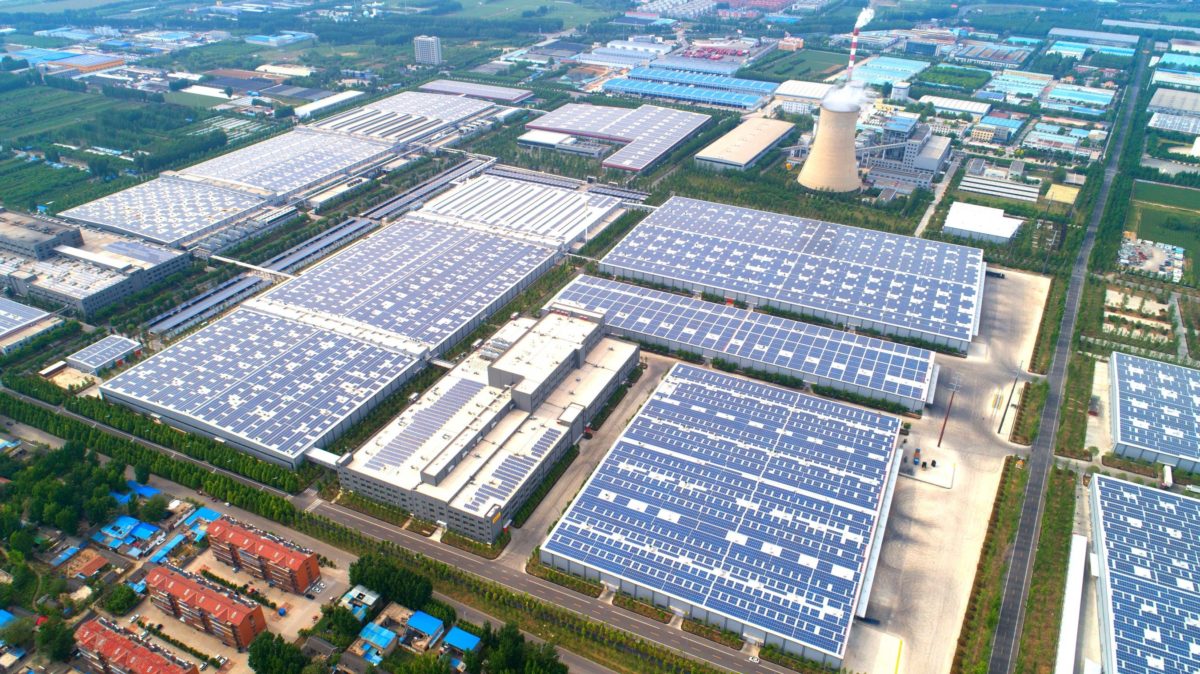
The world's largest rooftop solar power plant is powering a Chinese industrial park; source: PV Magazine
Fly over any major Canadian city and look down. Flat rooftops stretch for blocks—distribution centres, malls, grocery stores, big-box retailers, and industrial parks. Most of them sit empty under the sun. Collectively, they represent one of the largest unused pieces of infrastructure in the country.
Calgary alone contains well over 150 million square feet of industrial space. Amazon’s footprint in the city exceeds seven million square feet. A single modern fulfillment centre often spans 600,000 to one million square feet. Most of it sits exposed to the sun, doing nothing.
Solar requires roughly fifty square feet per kilowatt of installed capacity. That means one million square feet of usable rooftop could support about twenty megawatts of solar generation. Amazon warehouses in Calgary occupy some seven million square feet, representing around 140 megawatts of potential capacity. And that’s just one company, in one city.
Industrial rooftops alone could support over 17 gigawatts of solar generation, producing roughly 4.4 percent of Canada’s annual electricity demand.
- Author’s Calculation (See Appendix 11H - Estimating Canada’s Commercial Rooftop Solar Capacity)
Now scale that across Toronto, Vancouver, Edmonton, Montreal, Ottawa, Winnipeg, and every other major metropolitan area. Canada’s industrial inventory alone exceeds two billion square feet of warehouse and logistics space, much of it in single-storey buildings with vast flat roofs. Even after accounting for structural limitations, shading, and mechanical equipment, the usable potential quickly rises into the tens of gigawatts of distributed solar capacity.
Solar generation has a lower capacity factor than baseload sources such as nuclear or geothermal, averaging roughly 18 percent in Canada. But even at that level, 17 gigawatts of installed capacity would still produce more than 27,000 gigawatt-hours of electricity each year. That is enough energy to power roughly 2.5 million Canadian homes—more homes than exist in the entire Greater Toronto Area.
These numbers only reflect industrial rooftops. Expanding the model to include large retail complexes, shopping centres, schools, hospitals, and government buildings would push the national potential considerably higher—likely into the five to six percent range of total electricity demand.
Around 31% of Germany’s photovoltaic production comes from small arrays, most of which are on rooftops. They generated around 15 TWh of electricity in 2020.
- Renewable Energy Focus, Volume 42 (2022)
Germany provides a clear example of what widespread rooftop solar can look like in practice. The country has installed more than 117 gigawatts of solar capacity by the end of 2025, a large portion of it on residential and commercial rooftops, generating around 87 terawatt-hours (TWh) of electricity. That is almost six times what it was generating just five years earlier. On sunny days, solar power can supply more than one-third of Germany’s electricity demand, sharply reducing the need for fossil fuel generation during daylight hours.
Much of that generation comes not from massive solar farms, but from distributed systems installed across warehouses, office buildings, and homes. Millions of rooftops now contribute power throughout the day. In 2025 alone, Germany deployed 17.5 gigawatts of new solar capacity, demonstrating how quickly distributed solar can expand when the regulatory environment is clear and installation becomes routine. Once permitting barriers are reduced and rooftop solar is treated as standard infrastructure rather than a niche technology, deployment can scale rapidly across thousands of buildings at once.
During Germany’s solar expansion, the build-out also supported a large installation workforce. Tens of thousands of electricians, technicians, and construction workers were employed installing rooftop systems across the country. Many of those jobs are temporary by nature, declining as markets mature, but during the expansion phase they represent meaningful local economic activity tied directly to clean energy development.
The real value of rooftop solar is not simply how much electricity it generates. It lies partly in the economic activity created during installation, but even more in where that electricity is produced.
Remote solar farms require land acquisition, transmission expansion, and long development timelines. Rooftop solar avoids all three. The infrastructure already exists and the connection points are already in place. Most importantly, the electricity is generated exactly where it is consumed—inside the urban distribution networks that carry the heaviest daytime loads.
Since that electricity is produced locally, it reduces the amount of power cities must draw from the broader grid during high-demand periods. Every megawatt generated on a warehouse roof is a megawatt that does not need to travel across long transmission corridors or come online from a natural gas peaker plant.
Nuclear and geothermal plants can provide the steady baseload generation that anchors a clean grid. Rooftop solar plays a different, but complementary role. Spread across thousands of buildings, it quietly reduces daytime demand across the urban grid.
Calgary receives more annual sunshine each year than Rio de Janeiro, Brazil. Even Vancouver, despite its reputation for grey skies and rainy winters, receives more sunshine annually than parts of southern Germany—yet Germany has built one of the largest solar industries in the world.
- Author’s Calculation (see Appendix 11I – Canada’s Solar Resource Potential)
For grid operators, those reductions ease pressure on the system. Lower daytime peaks mean fewer emergency gas turbines ramping up during sudden demand spikes. Transmission upgrades can be delayed or avoided altogether. Utilities gain breathing room in systems that are often operating close to their limits.
Commercial rooftops therefore represent a form of distributed grid relief. They turn passive buildings into small power stations that support the stability of the system around them. The remaining question is how to implement it at scale. Two viable approaches exist.
The first is a mandate. Require all large commercial and industrial buildings above a certain footprint to install rooftop solar by a defined year. To make this politically and financially workable, the federal government would back low-interest loans delivered through private banks. Property owners finance installation over twenty to thirty years, repaying the loan through electricity savings and surplus power sold to the grid. The administrative burden remains minimal because the banking system handles underwriting and repayment.
The second approach is leasing. Government agencies or utilities lease rooftop space, install panels themselves, and connect generation directly to the grid. This approach appears simple, but it transfers operational complexity to government and creates long-term management obligations. The mandate-with-financing model keeps ownership, maintenance, and incentives aligned with the building owner. It scales more cleanly and avoids ballooning public payrolls.
There will be objections. Some roofs are aging. Some structures cannot handle additional load. Some businesses will resist capital expenditures even with favourable financing. These are real constraints, but they are not deal-breakers. Engineering assessments can determine structural suitability, mandates can be phased in gradually, and exemptions can be granted for buildings nearing the end of their lifecycle.
Commercial rooftops are already built. They are already connected to distribution networks. They sit directly above the businesses that consume electricity every day. Leaving them empty while debating new generation elsewhere makes little economic sense.
More importantly, it overlooks one of the simplest ways to reduce how much power Canada’s cities must draw from the grid in the first place. Rooftop solar cannot replace firm baseload generation, but deployed across thousands of buildings it can quietly reduce the amount of electricity cities must draw each day.
Install approximately 17 gigawatts of distributed rooftop solar capacity across Canada’s commercial and industrial buildings—warehouses, retail centers, malls, logistics facilities, and other large flat-roof structures—using Property Assessed Clean Energy (PACE) financing.
Under this model, installations are financed through long-term property tax assessments tied to the building rather than the owner. If the property changes hands, the repayment obligation transfers with it. This structure removes one of the largest barriers to adoption—the risk that a building owner pays for the system but sells the property before the investment has fully paid off.
Participation would be required for suitable commercial rooftops within a defined implementation period. Buildings that choose not to install solar would pay a levy instead, encouraging participation while allowing flexibility where installation is impractical.
Because installations are financed through property-tax-linked loans rather than direct public spending, the capital investment is funded primarily by private financing, not taxpayers. This policy effectively transforms millions of square metres of unused roof space into productive energy infrastructure while reducing electricity demand across Canada’s urban grids.
Under a PACE framework, private lenders provide the installation capital while repayment occurs through property tax assessments attached to each building. Because property tax obligations carry extremely low default risk, financing rates can remain relatively low while still attracting institutional capital.
This structure allows tens of billions of dollars in energy infrastructure to be deployed without requiring equivalent public spending.
Since repayment occurs through long-term property assessments, the electricity produced by rooftop systems typically offsets a large portion of each building’s power consumption. In many cases the value of the electricity produced can exceed the annual financing payment, creating immediate positive cash flow for building owners.
At a national scale, distributed solar installed through commercial rooftops would produce enough electricity each year to offset the power consumption of millions of homes while reducing strain on provincial grids during daylight hours. Because Canada’s electricity grid already relies heavily on low-carbon sources, the emissions impact is smaller than in fossil-dominated grids. However, distributed solar still reduces fossil generation, improves grid resilience, and offsets billions of dollars in electricity consumption each year.
Unlike centralized generation projects, these systems are built directly at the point of consumption, meaning a large portion of the electricity is used locally rather than transmitted across long distances. This approach avoids the land acquisition, transmission expansion, and long permitting timelines associated with large utility-scale solar farms.
* Full assumptions and calculations are provided in Appendix 11J – Estimating Canada’s Commercial Rooftop Solar Returns
Pillar I begins with a simple premise. Before Canada can transform the rest of its economy, it must first modernize the systems that already power it.
Electricity sits at the center of that challenge. Clean power does not solve climate change on its own, but without it many of the solutions that follow remain constrained or impossible. Electrified transport, hydrogen production, advanced manufacturing, carbon removal, and climate-resilient infrastructure all depend on abundant, reliable electricity. If the grid remains tied to fossil fuels, the transition stalls before it truly begins.
The first objective addresses that problem directly. We build approximately 18 gigawatts of new firm, emissions-free baseload power using a combination of nuclear and geothermal energy. That capacity is sufficient to replace nearly all of the electricity currently produced by fossil fuels in Canada while preserving the reliability that natural gas plants provide today.
But new infrastructure does not erase the existing system overnight. Natural gas plants already embedded in provincial grids cannot simply be shut down without risking price shocks, stranded assets, and instability in gas-heavy provinces. That is why the second objective focuses on retrofitting carbon capture onto roughly 17 gigawatts of high-utilization natural gas capacity, while requiring capture on any new large-scale gas facilities. This step alone prevents about 22 megatonnes of emissions each year, reducing the climate impact of infrastructure that must remain in operation while cleaner systems expand.
The third objective shifts attention from large power plants to the buildings that consume electricity every day. By installing approximately 17 gigawatts of distributed rooftop solar capacity across commercial buildings, Canada can generate roughly 27 terawatt-hours of electricity annually without acquiring new land or building long transmission corridors. Spread across warehouses, retail centers, and industrial facilities, rooftop solar reduces daytime demand on urban grids while turning idle rooftops into productive energy infrastructure.
Taken together, these three objectives form a coherent strategy for stabilizing the electricity system during the transition. Build the firm clean capacity required to replace fossil baseload. Contain emissions from infrastructure that cannot disappear overnight. Reduce pressure on urban grids by generating electricity directly where it is consumed.
None of these steps alone is sufficient. But together they begin shifting Canada’s power system away from combustion and toward long-lived, predictable energy infrastructure.
That shift matters because electricity underpins nearly everything that follows. A cleaner grid makes deeper decarbonization possible. It enables clean hydrogen production, supports industrial electrification, and strengthens the resilience of cities facing a changing climate.
Before Canada can build the energy systems of the future, it must first stabilize and clean the one it relies on today. Pillar I lays that foundation.
Pillar I deploys three major forms of energy infrastructure across Canada’s electricity system.
Firm clean baseload generation
Carbon capture retrofits
Commercial rooftop solar
Total infrastructure deployment
Capital sources
The investment required to clean the grid is large, but much of it represents infrastructure Canada will need to build regardless. Electricity demand is expected to grow significantly in the coming decades as transportation, industry, and building systems electrify. At the same time, much of the country’s existing fossil fuel generation will reach the end of its operating life.
The question is not whether Canada will invest in new power infrastructure. That will happen regardless. The question is what kind of infrastructure replaces the system that exists today.
Pillar I significantly expands Canada’s clean electricity supply while reducing emissions from the fossil infrastructure that remains in service during the transition.
New electricity generation
Grid impact
Emissions reductions
Total emissions reduction
* Full assumptions and calculations are provided in Appendix 11K – Estimating the Aggregate Returns of Pillar I
Together, these outcomes reshape the role of electricity in Canada’s climate strategy. Instead of remaining a source of emissions and instability, the power system becomes a platform for the broader transition ahead. Cleaner generation reduces emissions today while creating the capacity needed for electrified transport, hydrogen production, industrial decarbonization, and more resilient infrastructure. With the grid stabilized and expanding, Canada can begin building the systems that carry the rest of the economy toward a low-carbon future.
Curious about why I wrote this book? Read my Author’s Note →
Want to dive deeper? A full list of sources and further reading for this chapter is available at: www.themundi.com/book/sources
As a systems thinker, I weave together solutions from across disciplines to tackle the biggest challenge of our time.
Help shape the future! Sign up to receive behind-the-scenes updates, share your ideas, and influence the direction of my upcoming book on climate change.